

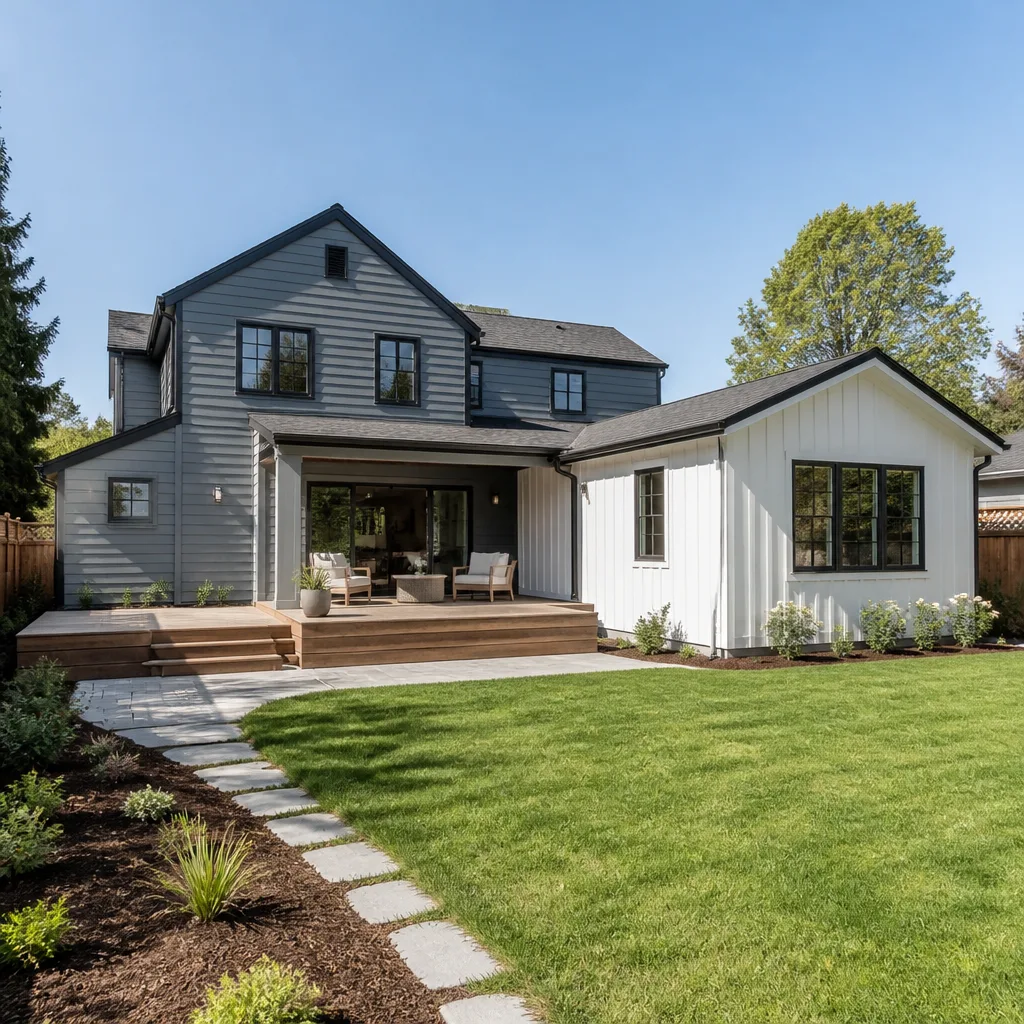
 Home additions & ADU
 Kitchen remodeling
 Bathroom remodeling
 Roofing
 Windows & doors
 Driveway & pavers
 Fence
Free written scope consultation - allowances, timeline, and change-order rules on paper before a single trade is scheduled
James Hardie Home Additions & ADU: The Miami Gardens Owner’s Guide
We build James Hardie-clad home additions and accessory dwelling units for Miami Gardens homeowners, and the installed cost for an addition runs about $53,100 – $153,400, with a stand-alone ADU from $106,200 – $259,600. Those are honest Miami Gardens numbers, mid-range finishes and a real permit. We’re an independent construction company, not affiliated with James Hardie, and we don’t run an office, yard or crew out of Miami Gardens. What we do is connect you with vetted local crews who hang HardiePlank, HardiePanel and HardieTrim the way the manufacturer wants it done.
Most owners don’t call us about a “part.” They call because a Hardie-clad addition they bought years ago has gone soft at a corner, or a paint job keeps failing along a south wall, or a joint that was supposed to stay sealed has opened up again. That’s the symptom picture we work with.
Which James Hardie Models This Applies To
James Hardie siding isn’t sold like a car part with a model year on the box. The product lines you’ll actually find on an addition or ADU in Miami Gardens are HardiePlank (lap siding, in Smooth and Cedarmill textures), HardiePanel (vertical), HardieShingle, and HardieTrim boards. Each comes in different thicknesses and in either factory-primed or prefinished “ColorPlus” versions. That distinction matters: ColorPlus comes off the factory with a baked-on finish and a written finish warranty, and if you replace a ColorPlus board with a primed board and paint it on site, the touch-up color will drift within two or three Miami summers. Sun kills paint.
To match what you have, measure the exposed face on a lap course (HardiePlank runs roughly 6-to-8-inch exposures on residential additions), check whether the panel has a wood-grain texture or is smooth, and look at the back of a removed piece for the mill stamp. That stamp tells you the product and thickness. Bear in mind that a lot of the “James Hardie problems” we see aren’t the board at all. They’re a fastening or flashing mistake made by whoever installed it, and the board is just the thing that failed first.
Styles & brands we work with
- Kitchen remodeling
- Bathroom remodeling
- Home additions & ADU
- Roofing
- Windows & doors
- Driveway & pavers
- Fence
Signs Your James Hardie Home Additions & ADU Is Failing
- Soft or spongy spots near the bottom of a wall or at outside corners. Water is getting behind the Hardie and the OSB or sheathing underneath is soaking it up. On a Miami Gardens addition, this is almost always a flashing or caulk failure, not a siding failure.
- Paint or factory finish peeling or bubbling along the south or west face. South Florida’s UV load is brutal, and a finish that wasn’t prefinished or wasn’t primed correctly will fail there first. If it’s peeling in sheets, something underneath it is wet.
- Caulk joints opening at trim, windows or corners. The joint opens and lets water in. Florida’s rain-and-dry cycle and the thermal movement of a Hardie-clad wall exaggerate that opening, and the gap grows quietly.
- Cracks in a Hardie plank or panel. These usually mean the piece was fastened too tight or nailed against a hard surface with no room to move. It’s a fastening problem showing up as a crack.
- Warping or a wavy wall surface. On an addition, this often points to a framing or sheathing problem behind the siding, which is why we look at the whole wall, not just the board on top.
See the difference
 Before
 After
 Before
 After
 Before
 After
Replacement Cost & What’s Included
For a full James Hardie-clad home addition in Miami Gardens, a realistic installed range is $53,100 – $153,400. A stand-alone ADU is $106,200 – $259,600, and converting an existing garage to living space runs $35,400 – $94,400. What drives the range on an addition is square footage, whether the foundation is a slab or an elevated structure, the window package (impact-rated windows are essentially standard here, and they add real cost), and the finish level inside.
Repairs land in a different bracket. Patching a failed Hardie corner, re-flashing a window, or replacing a run of siding is priced as a repair job, not a construction job. On the parts side, you’re buying the board, the trim, the caulk, and the fasteners; the labor is what you’re really paying for. Every scope, every allowance, and every change order is in writing before we touch the wall, so the number you agree on is the number you get. Every eligible job gets permits pulled and inspections signed, and every completed job carries our written 90-Day Done Right Promise.
DIY or Call Us?
An owner can safely do a few things. Look closely at the bottom course and outside corners for soft spots. Press on suspect areas with a screwdriver handle. Check whether caulk joints are cracked. Take photos and note where the water staining is. That’s all useful information, and it’s free.
What we don’t recommend is pulling siding boards off a finished two-story wall, or patching a flashing detail yourself. Hardie sits over the sheathing and the weather barrier, and if you open the wall and don’t re-flash it correctly, you invite the exact moisture problem you were trying to fix. On a real addition or a garage conversion, there’s also the permit issue. Those are structural and require drawings, permits, and signed inspections. We pull permits because the last contractor a lot of Miami Gardens owners used decided they were optional, and that decision comes back to bite at resale. Call (844) 797-8316 and we’ll walk through the wall with you.
FAQs
From 25 to 50 years depending on the product and on the finish. A factory-prefinished Hardie product holds up longer in Miami Gardens than a primed board painted on site, because our sun and salt air punish fresh paint hard. The board itself is durable; the finish and the flashing are the parts that age.
Yes, and it’s often the right call. If a corner or a run of siding failed because of a flashing or caulk detail, we repair that detail and replace only the affected boards. We only recommend full replacement when the moisture has spread into the sheathing across a wide area. An honest crew tells you which one you’re looking at.
A patch-and-flash repair is usually a short job, often a day or two. Replacing siding across a whole addition takes longer and depends on scaffolding, weather, and whether the wall behind it is wet. A full addition or ADU is a multi-week build with a permit in the middle. We’ll give you a real timeline in the written scope.
We measure the existing boards and read the mill stamp on the back, then match the product, thickness, texture, and finish. For ColorPlus repairs we match the finish line exactly so the color doesn’t drift. We don’t carry parts on a truck or claim to; we source the right board for your wall, then install it the way it was meant to be hung.
If your addition or ADU has a wall that’s telling you something, we’d rather you hear the answer now than after the next rainy season. Barrett & Sons Construction Miami Gardens serves Miami Gardens and nearby neighborhoods, and we also handle KraftMaid, Cambria, and Silestone work if the project reaches the kitchen or bath. Call (844) 797-8316 for a free estimate.
Written by the team at Barrett & Sons Construction Miami Gardens, serving Miami Gardens and nearby areas.